March 12, 2026
My Favorite Class in Lifeship (The Best one as well)
Why Comms Tech is my favorite (and best) class!


This article will serve as the first in a mini-series of posts about the core mechanics found in Lifeship. Here, we will have a brief overview of many of the mechanics that we are excited to share; some of which will appear familiar to those that have played similar skirmish campaign games, while others are unique to Lifeship as far as we are aware. Each mechanic featured in this article will have its own more in-depth article.
Many of these mechanics can be found in our Print and Play prelude, available at https://www.ikarangilabs.co.nz/print-play. However, some will have to wait until the full game release to be seen in their full glory.
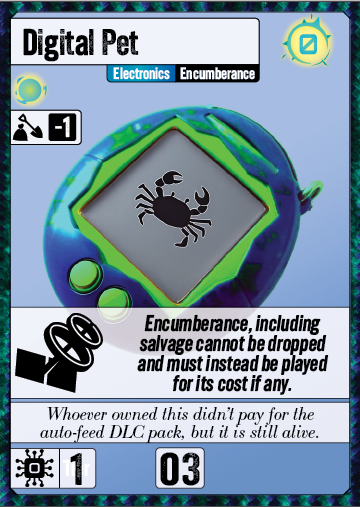
Salvaging is one of the major methods of meta progression. This ranges from crafting items for personal use (equipment), constructing buildings on the LifeShip, to converting salvage to ship resources such as food or morale.
Each mission has a number of salvage piles available on the map, which can be picked up using a Salvage action (one of the 4 basic actions). When a player does this, they look at the top X cards of the salvage deck, and takes half as many cards, rounded down. For example, a player with salvage 3 will look at the top 3 cards, and take 1. The taken card is added to the players' discard, and generally has no positive effect when drawn later in the mission. The remaining cards are returned to the bottom of the salvage deck in any order.
Because every turn you draw until you have 5 cards, each salvage card drawn is wasted potential, but higher tier salvage tends to cost more energy to drop. Many players focusing on an early burst of salvaging have fallen victim to drawing a dead hand at an inopportune moment!
Fortunately, there are a few different ways to deal with salvage gumming up a deck. First - when a player successfully completes a rest (ie playing no cards for the turn, including defences), they may discard any number of cards from their hand for free!
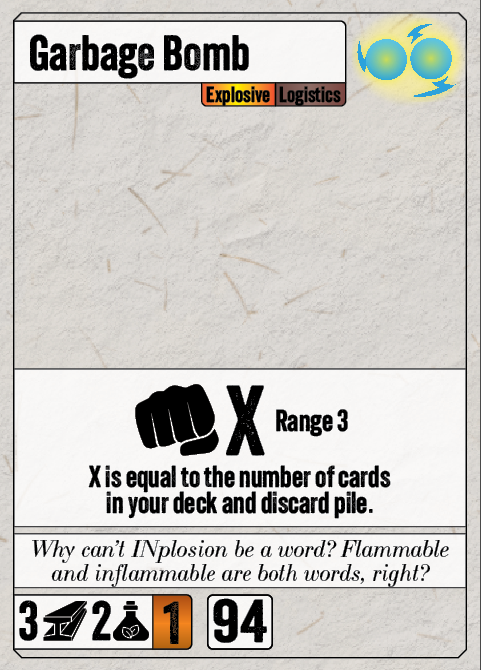
Second - Several items and class cards are dedicated to reducing the burden on Super Team members planning on getting their hands dirty. Backpacks can store dropped salvage, sifting a player deck allows you to discard cards you would otherwise draw on a following turn, and Garbage Bomb can turn an overly full deck into a powerful attack
In Lifeship, turns are taken at the same time. There’s much less waiting for one player’s turn to be over, and when the round changes phases, it does so for everything at the same time.
At the start of the turn, players will choose which cards in their hand they intend to play, and place them into their initiative queue. Each card that is played will have their own initiative number. In the action phase, the turn moves up the initiative values from 0 up to 100. When it reaches the initiative of one of the cards you placed into the initiative queue, then you get to pay costs, and play the card.
Similarly, enemy actions have their own initiative values, allowing for players to plan their actions out, and react to the enemy’s intentions. This also means there is a push & pull between the players and the enemies - there is no ‘player turn’ and ‘enemy turn’.
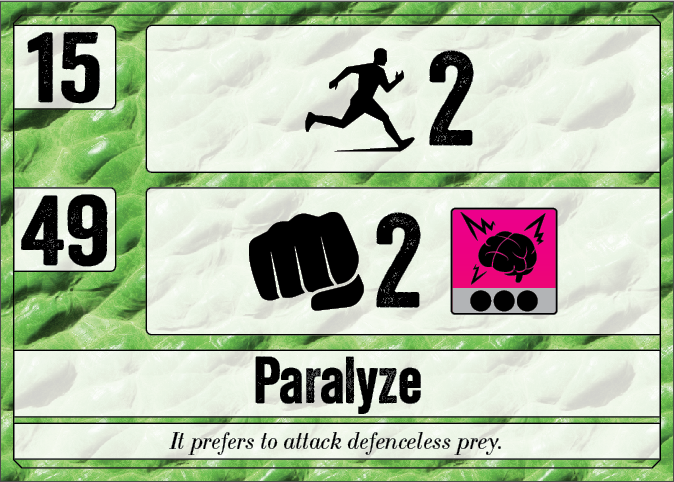
Enemies work off a set of rules that determine how they choose targets, and where they move. In short, enemies will move towards the closest Super Team member (the players and their allies) and try to become adjacent to as many Super Team members as possible. For attacks, they will target the closest valid target. Both of these actions will use the lowest initiative as a tiebreaker when there are multiple valid targets equidistant from the enemy.
Just like the players, enemies will play a number of actions throughout the turn. At the beginning of the turn, once players have selected their cards, each enemy deck will reveal one card, and all enemies of that type will perform the actions on the listed initiative.
In some missions, even the environment can be as inhospitable as the enemy. Environment decks tend to affect the whole map board, and can modify all actions on a turn causing attacks to be deadlier, or take actions on an initiative such as slamming all figures in a specific direction. These can represent the vacuum of space, impacts of asteroids against the shuttle, or even an actively erupting volcano just to name a few.
Some environment 'decks' are represented with a single card that act as a modifier on the whole mission, while other environments have an 8 card deck similar to enemies which introduces chaos and unpredictability to the map. Often, the Super Team are less equipped to deal with the environment than the denizens that have spent their time adapting to the environment, so enemies tend to have abilities that resist the hostile effects of the environment.
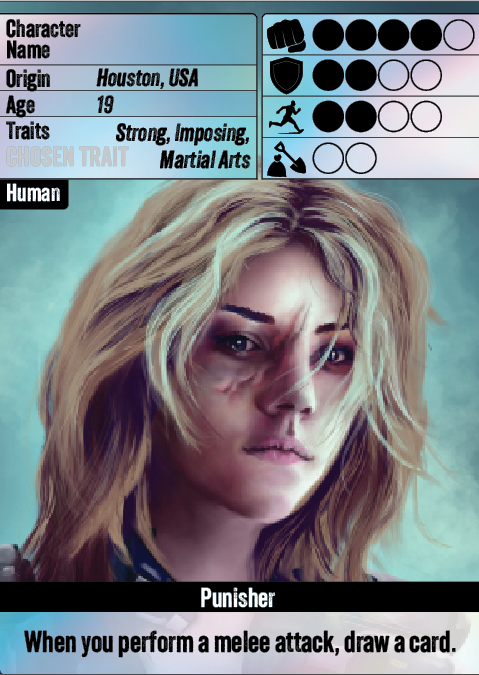
The Super Team is a revolving roster of characters. Each character, along with their bespoke backstory, abilities, and character cards, have a unique ambition; what they want to achieve during their time in the Super Team. These can range from personal growth and increasing their own stats, completing a project, or improving the life for all citizens of the Life Ship. When an ambition is met, the character retires from the Super Team, enjoying a life of relative safety on the Life Ship. That player will then gain a number of benefits such as improving their attack modifier deck, having an opportunity to buy ship resources not otherwise available, and sometimes permanent benefits to the Life Ship, such as unlocking discounts for crafting items. The character also adds their expertise to the Life Ship loosely based on their accomplishments, allowing for further unlocks as the Super Team introduces more experienced members to the Life Ship.
However, fulfilling an ambition is not the only way for a character to leave the Super Team. Many of the missions are dangerous expeditions to unknown lands. Whenever a character dies, they are cloned using the ships clone bay. Unfortunately, this is not a perfect process, and each time a character is cloned they receive increasingly severe mutations. Once a character has died 4 times, they are no longer able to be cloned, and permanently die. To prevent a downward spiral of failure, mutations are generally positive cards, and when a character permanently dies, a (smaller) number of benefits are passed on to the Life Ship, similar to fulfilling the ambition.
To also promote players experimenting and trying new classes and characters, there is also a 'middle' option. If you're just not having fun playing a class or character, there is always an option to just retire without suffering through 4 missions and dying each time or fulfilling an ambition. To reduce the ability to abuse this with retiring characters after single missions, there are very few benefits to retiring this way, but we don't want players to feel locked to a choice that they're just not enjoying.
In the interest of this article not being too long and me rambling, this is where we will end this article. There are many other aspects of Lifeship that we are excited to share and talk about which will be included in a part 2, such as the timeline and how players select missions, events and encounters, further meta progression, the player controlled automaton to increase player count and allow for solo-play, and the website companion that helps run the game and allows for more dynamic storytelling. As mentioned at the beginning of this article, each section covered here will have its' own article going into more detail.
If you can't wait for the full Lifeship experience, or want to see some of these mechanics in question, we have a Print and Play prelude available for download now! The Prelude features a bespoke story leading up to the events of the main game and a selection of mechanics covered above to showcase the game. The prelude is available here: https://www.ikarangilabs.co.nz/print-play